Personalized AI-Assisted Threat Hunting with OpenClaw
A practical overview of integrating OpenClaw into detection engineering workflows to enable chat-based threat hunting and investigations via Telegram or WhatsApp.
THREAT HUNTING
f0xyPr0xy
2/2/20262 min read


The evolution of AI has entered a new phase, marked by the rise of OpenClaw as a personalized AI assistant that unlocks a wide range of operational capabilities.
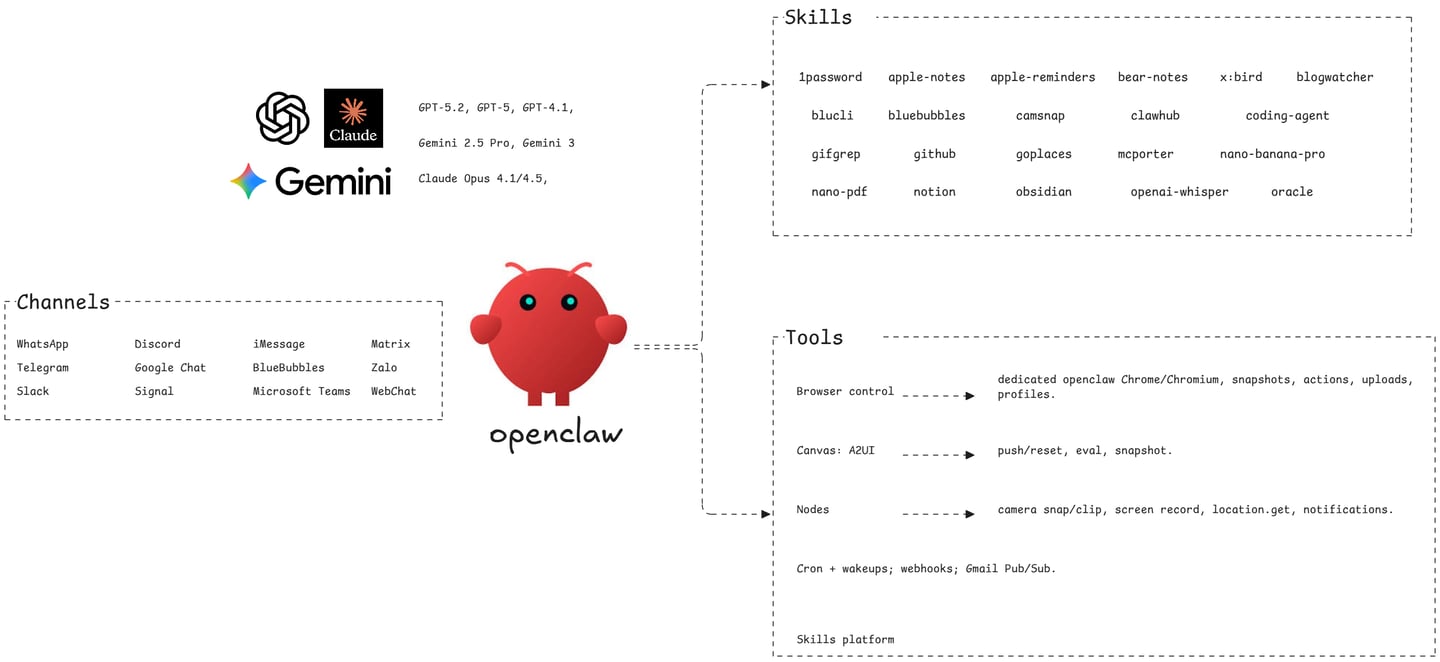
Its true strength lies in deep integration and customization, enabling support for 50+ integrations alongside core capabilities such as running locally on your machine, interacting through any chat interface, maintaining persistent memory, and controlling the browser.
Additionally, OpenClaw seamlessly integrates with multiple LLM modules, creating a flexible and powerful AI-driven ecosystem.
What does it do ?
OpenClaw functions as an AI-integrated personal assistant that operates with controlled access and defined privileges to execute user-driven tasks. It accepts inputs from multiple communication channels such as Telegram, WhatsApp, and other chat interfaces allowing users to interact with the assistant in the medium most convenient to them.
Powered by LLMs, the assistant interprets user intent, reasons through complex requests, and dynamically enhances its capabilities to meet specific requirements. Beyond conversation, OpenClaw can securely connect to and interact with various services, tools, and platforms to gather information, trigger workflows, and perform real-world operations. This combination of multi-channel interaction, intelligent reasoning, and deep service integration enables OpenClaw to act as a truly personalized, action-oriented AI assistant rather than just a conversational interface.
How can be used in hunting threat
In the context of detection engineering, OpenClaw can be integrated as an AI-driven hunting and investigation assistant that brings security operations directly to the analyst’s fingertips. Imagine initiating a threat hunt or an incident investigation from your mobile device via Telegram or WhatsApp without needing to log into multiple dashboards or SIEM consoles.
By leveraging AI-powered intelligence, the assistant can interpret high-level analyst intent, translate it into structured hunting queries, correlate signals across data sources, and guide investigations in real time. Analysts can request log analysis, anomaly detection, hypothesis validation, or enrichment tasks through simple chat commands, while the assistant orchestrates the underlying tools and data pipelines.
The illustrated architecture overview highlights how the Telegram-based hunting bot operates end to end—capturing user input, processing it through LLM-driven reasoning, interfacing with detection and telemetry sources, and returning actionable insights back to the analyst.
The below architecture demonstrates how conversational AI can evolve into a practical detection engineering interface, enabling faster triage, continuous hunting, and more responsive security operations.
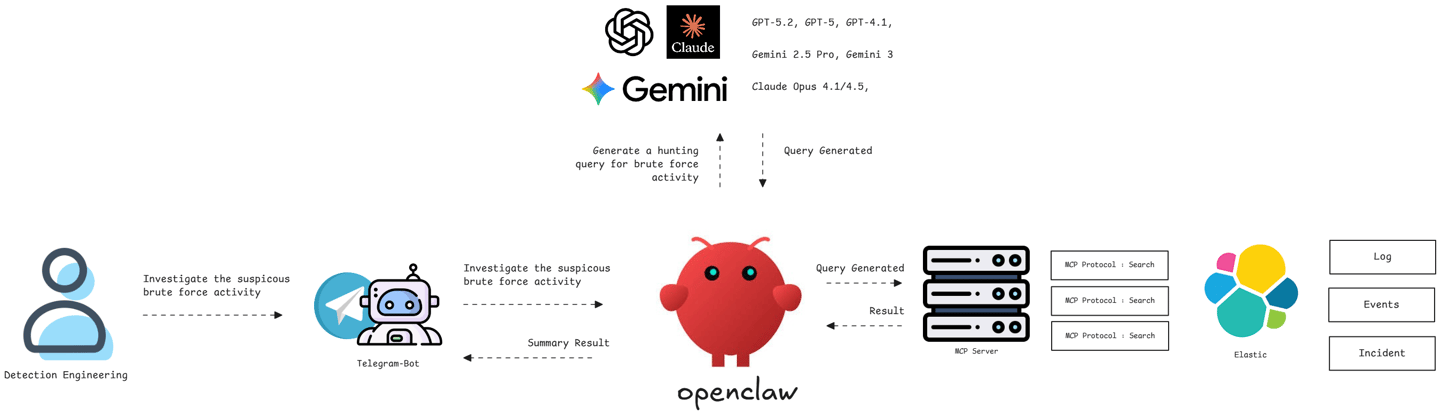
By integrating these capabilities, the system can automatically translate an initial hypothesis into focused sub-questions, identify the relevant data sources, execute validation checks in a logical sequence, and determine whether deeper investigative pivots are required.
Practical Demo

All rights reserved © 2025 - Present MalwareHunts. For educational and research purposes only. MalwareHunts is not responsible for any misuse of the information provided.